
When Knowledge Becomes Executable
AI is shortening the distance between knowledge and action. As access becomes easier, judgment matters more.

For a long time, there was a natural distance between knowing something and doing something with it.
A scientific paper could describe a method, explain why it worked and publish the results. But if someone wanted to use that method, they still had to understand enough of the work to reproduce it, adapt it and decide whether it made sense for their own problem.
AI is starting to compress that distance.
Paper2Agent is a good example. It turns scientific papers, together with their code, data and workflows, into agents that can actually use the research. A method can be applied to new data, an analysis can be reproduced, and different pieces of research can become much easier to work with.
That is more interesting than simply making papers easier to read. It makes knowledge easier to act on.
Search made information easier to find. LLMs made it easier to explain and explore. Agents are now making it possible to move from understanding a method to using it with much less distance in between.
That is a powerful shift. It can make expertise more accessible, help research travel across disciplines and remove a huge amount of technical friction that has little to do with the actual idea.
But it also changes where the difficult part of the work sits.
When access is hard, a lot of effort goes into finding and applying knowledge. When access becomes easy, more of the value moves into deciding what knowledge to use, when to trust it, what to question and how to combine it with everything else we know.
In other words, the bottleneck starts moving from access to judgment.
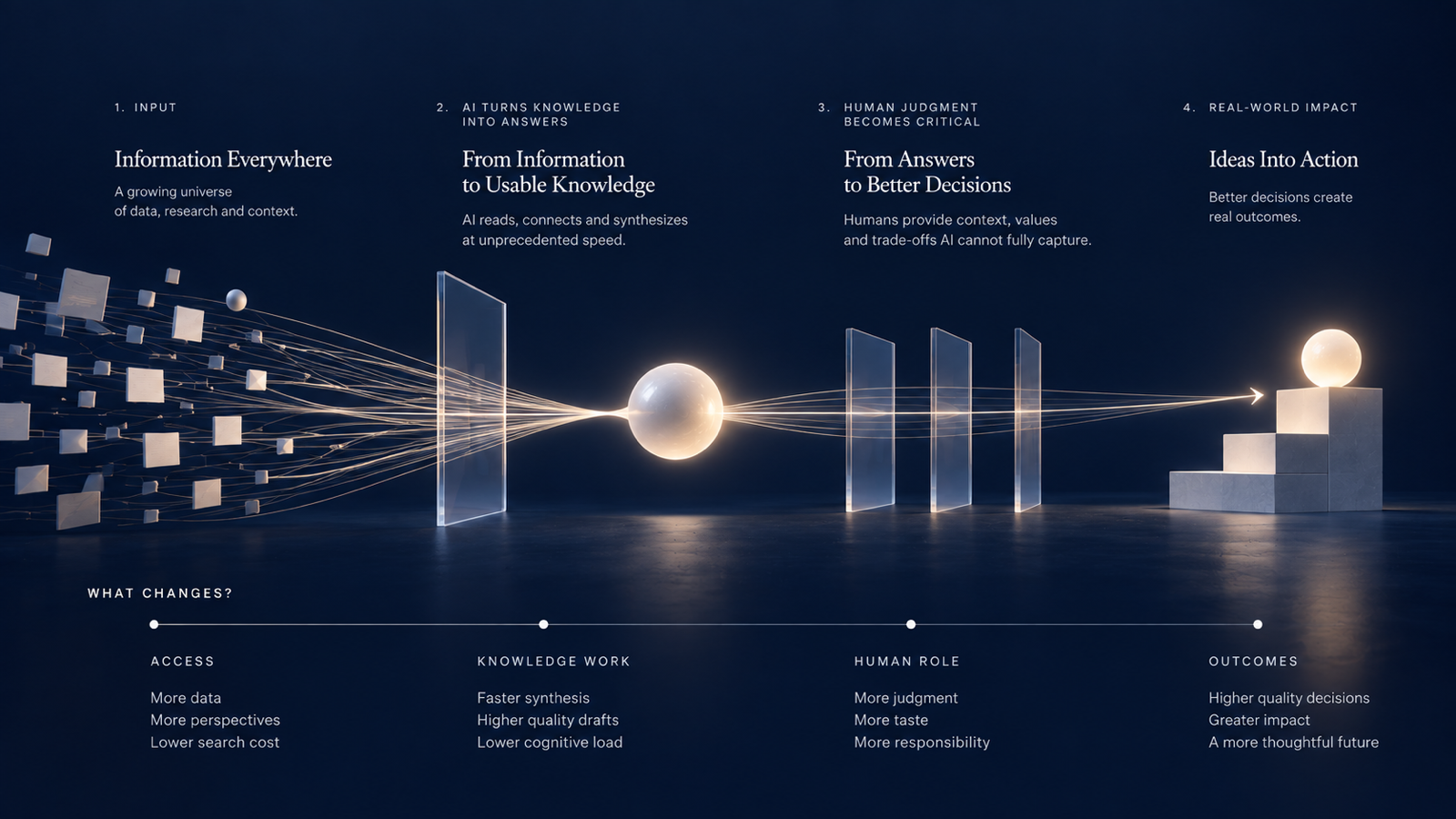
That is why the idea of using AI as a sparring partner rather than an oracle feels important here.
If AI can already find the information, explain it and increasingly act on it, then simply producing the answer may not always be the most valuable thing it can do. Sometimes the better role is to challenge the assumption behind the question, surface another interpretation or make a weak part of the reasoning visible.
The point is not to add friction back for the sake of it. It is to recognize that removing technical friction and removing human judgment are two very different things.
The better AI becomes at turning knowledge into action, the more important that distinction becomes.
There is another consequence too. When AI starts connecting research, applying methods and contributing to new work, keeping the path back to the source becomes more important. Recent discussion around AI and scientific attribution is one early sign of this.
If knowledge becomes easier to recombine and act on, understanding where an idea or method came from becomes part of preserving trust around the result.
This may be where thoughtful AI becomes especially relevant.
The goal should not be to keep every step difficult enough that humans are forced to understand it. Technology has always progressed by hiding unnecessary complexity.
But as more knowledge becomes executable, good systems should make the easy parts easier while keeping the important parts visible.
What are we relying on? What are we assuming? Where did this come from? And when does human judgment still matter?
AI is making the distance between knowledge and action much shorter.
The interesting question is what we choose to keep inside that distance.
See you in a Thoughtful Future.
References
Gao, Y. et al. (2026). Paper2Agent: Reimagining research papers as interactive and reliable AI agents. Nature. https://www.nature.com/articles/s41586-026-11044-y
Schmitt, M. (2026). Use AI as a sparring partner, not an oracle. Nature. https://www.nature.com/articles/d41586-026-02846-1
Nature Editorial (2026). AI companies must work with the research community to protect attribution. Nature. https://www.nature.com/articles/d41586-026-02886-7