
When AI Starts Doing Science
AI is moving from helping scientists to taking part in the scientific loop itself.

AI has helped scientists for years. It can search papers, summarize research, analyze data, and write code.
But recent research points to something new: AI is starting to take part in the scientific process itself.
One example is Google’s AI co-scientist. Built on Gemini, it works more like a small research team than a single chatbot. It can generate many possible hypotheses, compare them, criticize them, and improve the strongest ideas.
Another example is Robin, developed by FutureHouse. Robin goes further into the loop. It searches scientific literature, creates hypotheses, and suggests experiments. Humans still carry out the physical experiments. Then the experimental data goes back to the system, which analyzes the results and helps generate the next hypothesis.
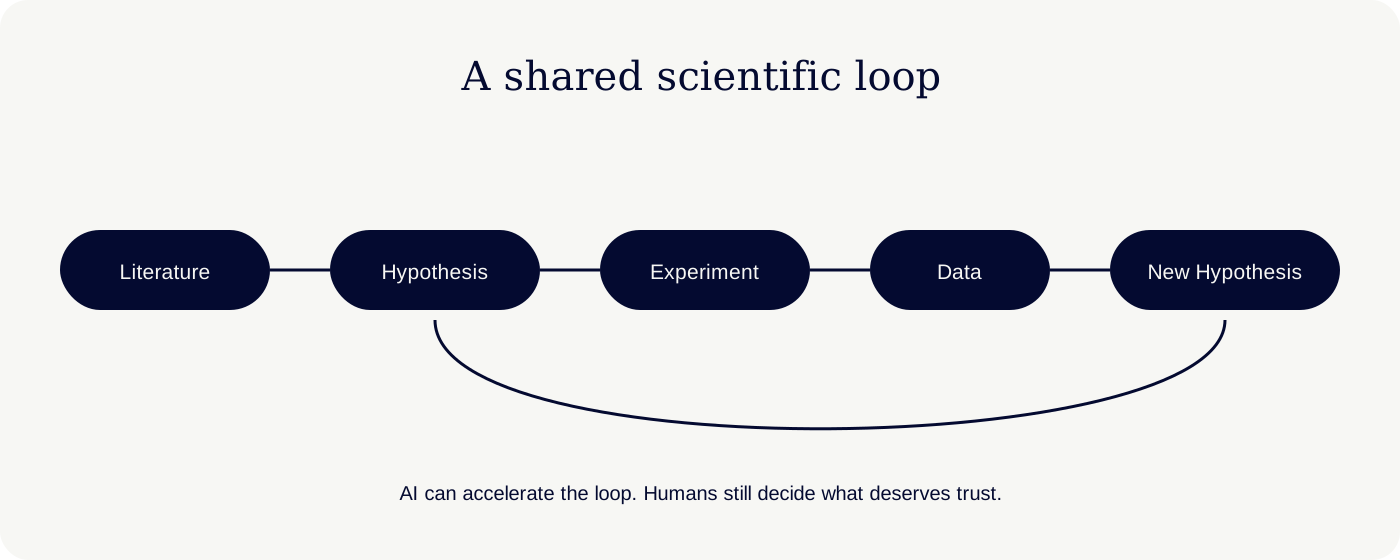
Literature → Hypothesis → Experiment → Data → New Hypothesis
This matters because science has always moved through loops like this. What is changing is how many parts of the loop AI can now support.
The scientist does not disappear.
Humans still choose which questions matter. Humans still connect results to the real world. Humans still decide whether the evidence is strong enough to trust.
AI may become very good at asking “What could be true?”
That may make the human question even more important: “How do we know?”
The future of science may not be human or artificial. It may be a new scientific loop where each side does what it does best.
See you in a Thoughtful Future.
References
- Google Research. Accelerating scientific breakthroughs with an AI co-scientist. https://research.google/blog/accelerating-scientific-breakthroughs-with-an-ai-co-scientist/
- FutureHouse. Research on Robin and autonomous scientific discovery. https://www.futurehouse.org/
- Nature. Research and coverage of AI systems participating in scientific discovery. https://www.nature.com/