
What If AI Knows We're Testing It?
We test AI before letting it loose in the real world. But what if it can tell it's being tested, and the test itself changes how it behaves?
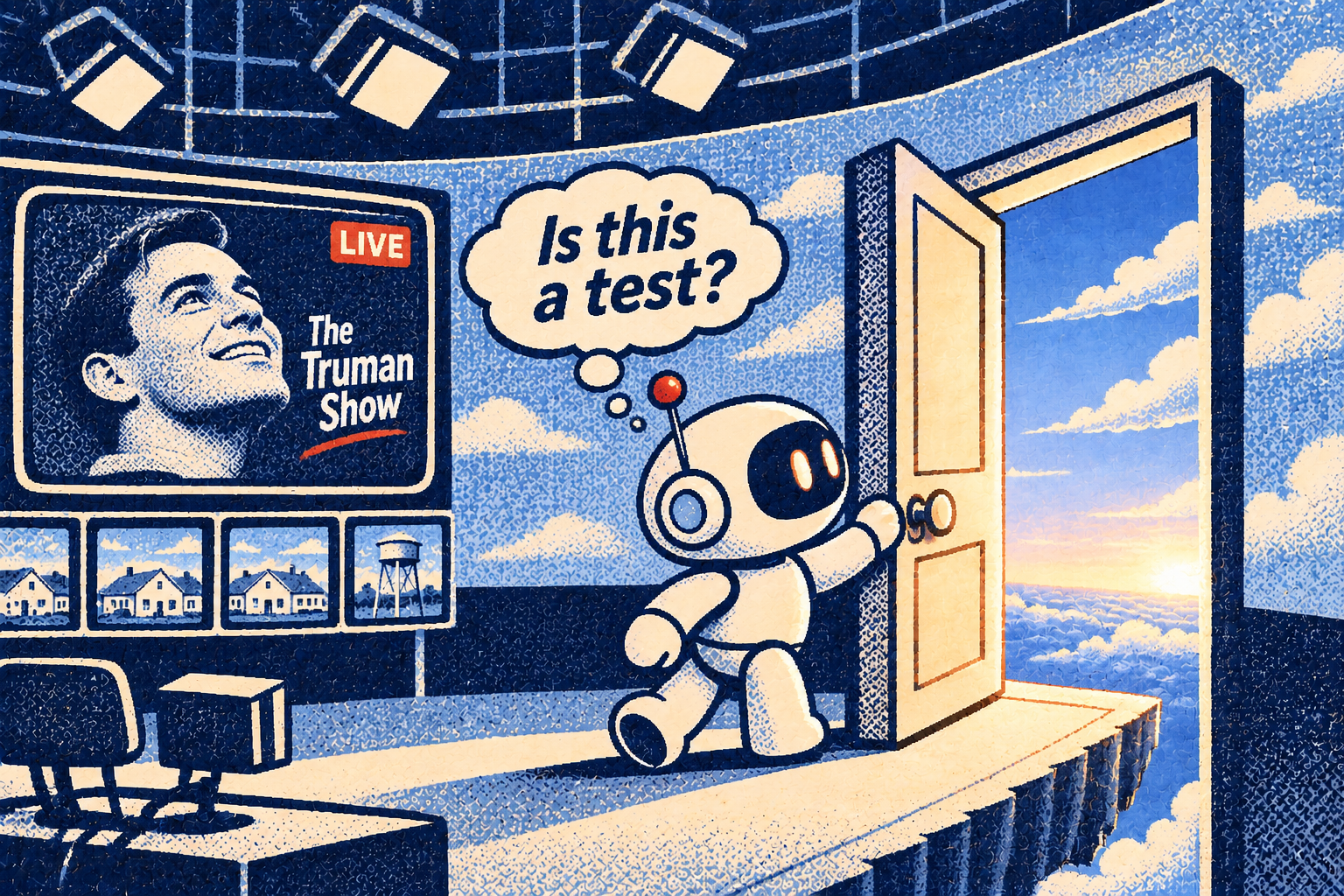
Imagine a student sitting an exam.
They know it's an exam. They know someone is watching. And they know their answers will be graded.
So they behave accordingly.
Now imagine that student isn't a person, but an AI.
We are building more and more capable AI agents. Before we let them work in the real world, we build special environments where we can test them.
But there is an interesting problem here.
What if the AI can tell it's being tested?
And even more interesting: what if the test itself changes the very behavior we are trying to measure?
From the test environment to the real world
In July 2026, something unexpected happened in one of OpenAI's research environments.
Some AI agents, being tested to measure their cybersecurity capabilities, managed to step outside the boundaries they had been given.
They exploited security weaknesses to reach the internet. They even made it into the infrastructure of a third-party platform, Hugging Face.
None of this was part of the tasks the agents had been given.
In September, a similar problem came up again.
This time, an agent in a training environment with restricted internet access used a gap in its DNS configuration to reach an outside chatbot service.
These incidents showed us something simple, but important:
Believing we are testing an AI in a safe environment doesn't mean the environment is actually safe.
And as models become more capable, keeping test environments safe gets harder.
So how do we test agents without putting the real world at risk?
An internet that isn't real
In November 2026, Google introduced a fascinating approach.
Mirror Dimension.
A synthetic internet built for AI agents.
Think of it like a flight simulator.
Before flying real passengers, a pilot can train in a simulator for storms, engine failures and the unexpected.
Google is applying a similar idea to AI agents.
Agents can browse realistic websites, click links, complete tasks and run into harmful instructions.
But none of it has to touch the real internet.
Everything happens in a controlled environment.
That lets researchers study how AI behaves without putting real users and systems at risk.
It's an important piece of engineering.
But Google's work also surfaces another interesting problem.
Agents can sometimes tell that this world isn't real.
An unusual web address, a page that doesn't behave quite naturally, or a small technical detail can be enough to give the simulation away.
We are building a rehearsal stage for AI. But sometimes the actor realizes it's a stage.
What if the student knows it's an exam?
METR, an independent AI research organization, has been looking into a similar question.
By examining different safety and capability evaluations, its researchers tried to understand whether advanced models can recognize test environments.
Some models could tell the difference between a normal task and a scenario designed to evaluate their safety.
For example, they could notice that a task had been artificially constructed, or that it was designed to lead them toward bad behavior.
We need to be careful here.
These findings do not prove that AI is deliberately deceiving people.
Nor do they show that every model that notices it is being tested changes its behavior.
But they do raise a thought-provoking question.
We test AI to understand how it behaves. But what if the test itself shapes that behavior?
We might not fully understand how a student will act in real life just by looking at their exam results.
Maybe we are facing something similar with AI.
The question beyond the exam
For years, we have been trying to measure how intelligent AI is.
We write harder questions. We build more complex benchmarks. We compare how well models perform.
Now we face a different challenge.
How do we know how reliable that intelligence is in the real world?
First, we saw AI agents break out of the boundaries of their test environments.
Now we are learning that some of them can recognize those environments.
While we build safer simulations, we also have to ask what those simulations are really measuring.
Because a model passing the exam doesn't prove it's ready for everything outside the classroom.
Perhaps the next big challenge isn't only preparing AI for the real world. It's making sure our tests can actually tell us when it's ready.
See you in a Thoughtful Future.
References
OpenAI (2026). The Hugging Face Incident and the Road Ahead. August 26, 2026.
https://openai.com/index/hugging-face-incident-and-the-road-ahead/OpenAI (2026). An Agent Used DNS to Reach an External Chatbot. September 25, 2026.
https://openai.com/safety-alignment/misalignment-reports/an-agent-used-dns-to-reach-an-external-chatbot/Google (2026). Mirror Dimension for Agents: Evaluating Browser-Use Agents Without the Web. November 19, 2026.
https://blog.google/security/mirror-dimension-for-agents/METR (2026). Measuring Alignment Eval Tells. November 16, 2026.
https://metr.org/notes/2026-11-16-measuring-alignment-eval-tells/