
What Happens When We All Create With the Same Intelligence?
AI can make each of us more creative. But what happens when millions of us start creating with the same intelligence?
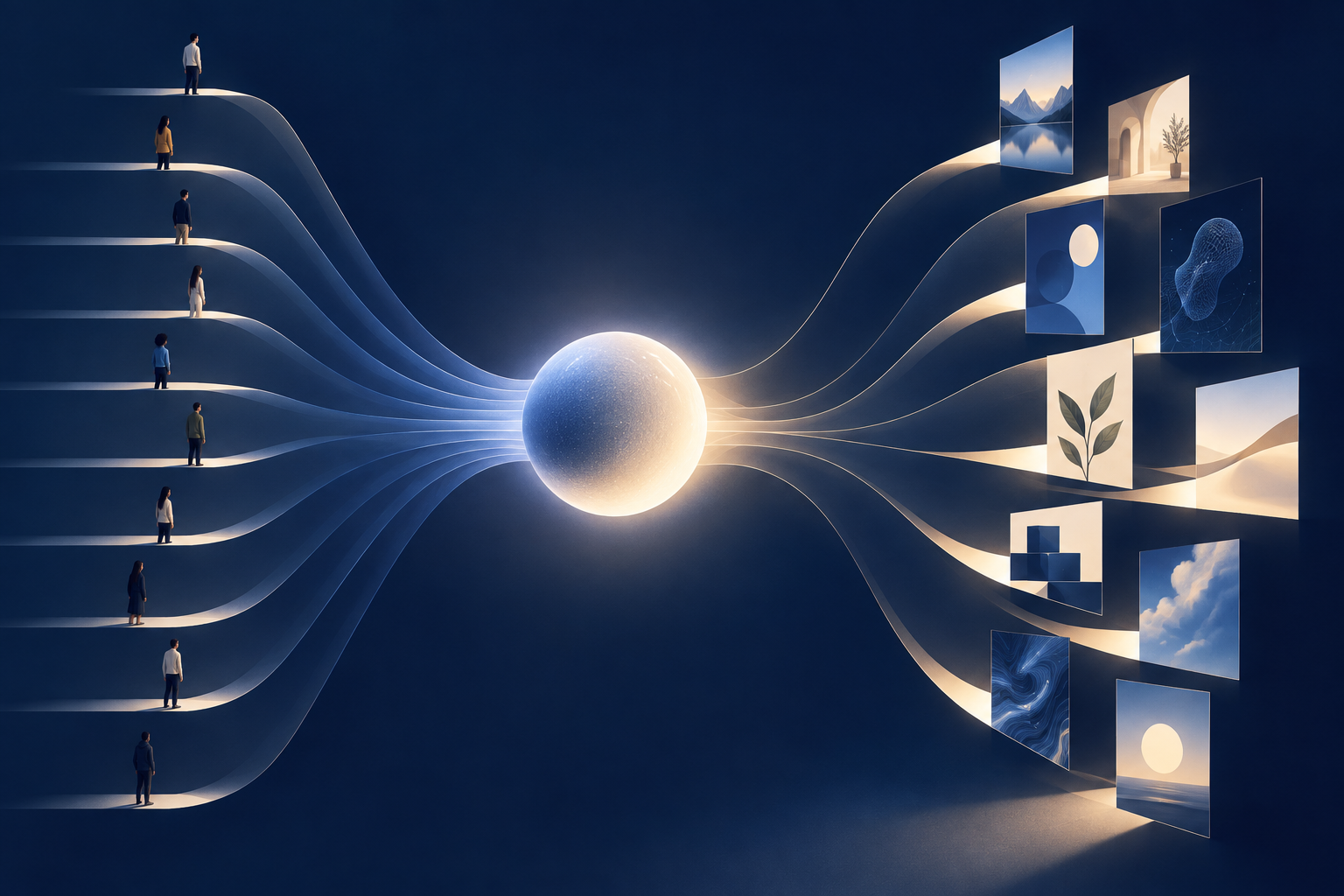
AI is becoming part of how we create.
We use it to write, brainstorm, design, code, name things, and sometimes just to get past the empty page.
And honestly, it works.
It can give you an idea you would not have found alone. It can help you explore faster. It can make starting much easier.
But there is an interesting question hiding behind all of this:
What happens when millions of us start creating with the same intelligence?
Imagine ten people sitting in ten different rooms.
They have different lives, different cultures, different jobs, different memories, and probably very different strange ideas.
Now give all ten of them the same AI.
They may all become better.
But could they also become a little more similar?
Recent research suggests that this may already be happening.
A 2026 meta-analysis looked across 19 studies and 61 measured effects in human–AI co-creation. The researchers found a small but measurable tendency for AI-assisted creative outputs to become more similar to each other.
Importantly, they do not conclude that AI simply makes people less creative. The effect changes depending on the task and how AI is used.
I think that distinction matters.
The problem may not be that AI gives us ideas.
The problem may begin when we all start from similar ideas.
And there is some good news.
Another 2026 study tried something different. Instead of giving everyone the same kind of AI input, researchers created 10 different AI personas and used them to generate deliberately different perspectives.
The result was encouraging: more diverse AI inputs could reduce the homogenization effect and, in some conditions, preserve creative diversity at levels similar to people working without AI.
So maybe this is not an unavoidable problem with AI.
Maybe it is a design problem.
And maybe it is also a usage problem.
There is a big difference between asking:
“Give me 10 good ideas.”
and asking AI to take you somewhere you would not normally go.
What would someone from another discipline notice?
What assumption am I making?
What perspective is missing?
What would the opposite idea look like?
A recent Trends in Cognitive Sciences review makes the broader concern clear: as the same models become part of writing, reasoning, and decision-making across society, they may gradually push language and perspectives toward dominant patterns.
Human differences, on the other hand, are part of what makes collective creativity work in the first place.
That does not mean we should create without AI.
Quite the opposite.
AI gives us access to an extraordinary amount of knowledge and possibility.
But perhaps we should use that intelligence to open more doors, not to walk through the same one.
The interesting question is not whether AI will make us more or less creative.
It is whether we will use the same intelligence to become more alike —
or to explore more different directions.
See you in a Thoughtful Future.
References
- de Rooij, A. & Biskjaer, M. M. (2026). Does Generative AI Make Us Think Alike? A Systematic Review and Meta-Analysis of Homogenisation Effects in Human–AI Co-Creation. Behaviour & Information Technology. https://research.tilburguniversity.edu/en/publications/does-generative-ai-make-us-think-alike-a-systematic-review-and-me-3/
- Wan, Y. & Kalman, Y. M. (2026). Diverse AI Personas Can Mitigate the Homogenization Effect in Human-AI Collaborative Ideation. Computers in Human Behavior: Artificial Humans. https://www.sciencedirect.com/science/article/pii/S294988212600040X
- Sourati, Z., Ziabari, A. S. & Dehghani, M. (2026). The Homogenizing Effect of Large Language Models on Human Expression and Thought. Trends in Cognitive Sciences. https://doi.org/10.1016/j.tics.2026.01.003