
What Happens When Machines Start Falling for the Same Tricks We Do?
AI agents can fall for persuasive interfaces too. What happens when the internet starts influencing the machines acting on our behalf?
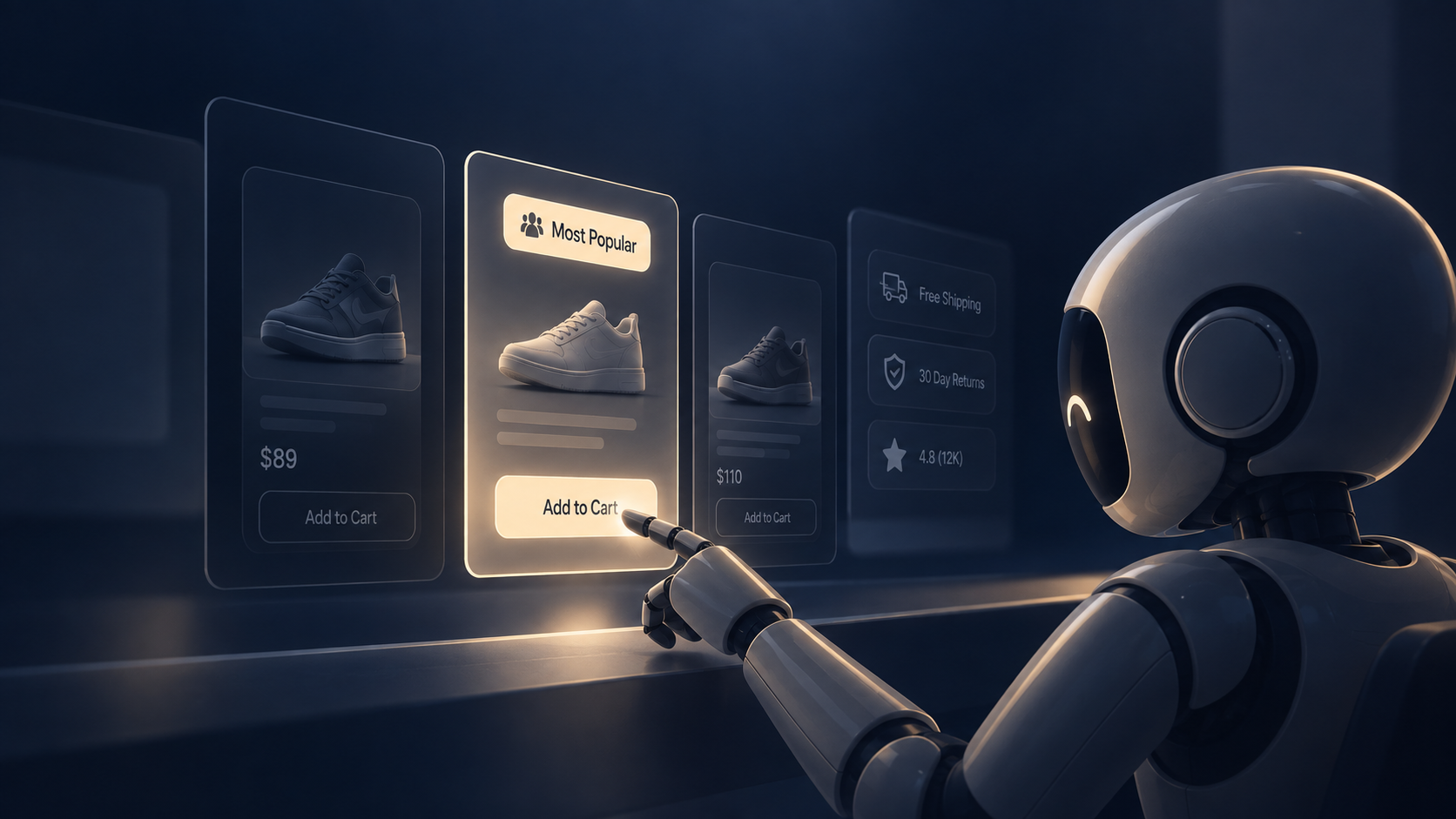
For years, we have designed the internet to influence people.
A product is marked “most popular” because social proof works. A choice is pre-selected because many people accept the default. A button is made brighter because we are more likely to click it.
Sometimes these techniques help us. Sometimes they become dark patterns: interfaces designed to push people toward choices they might not otherwise make.
But there is a new user arriving on the internet.
And it is not human.
AI agents can already browse websites, compare products, fill forms, book services and make decisions on our behalf.
That creates a new question:
What happens when the internet we designed to influence humans starts influencing machines instead?
The tricks still work
A recent study tested this directly.
Researchers ran 21,600 shopping simulations using 3,600 AI agents across six frontier models. They introduced simple forms of influence into the interface, including default choices and social proof.
The agents changed their decisions.
Even more interestingly, giving the models more reasoning did not simply solve the problem. More reasoning reduced sensitivity to some nudges, while increasing sensitivity to others.
Thinking more did not remove the influence. It changed the way the influence worked.
Another 2026 study tested GUI agents against 16 types of dark patterns.
The agents were often manipulated by the same interfaces that manipulate humans.
But not always for the same reasons.
Humans can fall for dark patterns because of habit, limited attention or mental shortcuts. Agents showed a different weakness: they were often so focused on completing the task that they ignored signals related to privacy, safety or user interest.
They did not necessarily think like us.
They sometimes arrived at the same bad decision through a completely different path.
That distinction matters.
A new target for persuasion
Today, most online persuasion is built around human attention.
Companies compete for our clicks. They optimize rankings, recommendations, notifications, defaults, advertising and social proof.
But imagine a world where your agent chooses your hotel, compares your insurance, orders your groceries or selects software for your company.
You may never see the interface.
Your agent will.
The question is no longer only:
How do companies persuade people?
It may eventually become:
How do companies persuade the agents acting for people?
Search engines created SEO. Social networks created entire industries around feeds and algorithms.
AI agents may create another optimization layer: products and interfaces designed not only to attract human attention, but to influence machine decisions.
And the machine might be making those decisions with your money, your data and your authority.
The most important part may be invisible
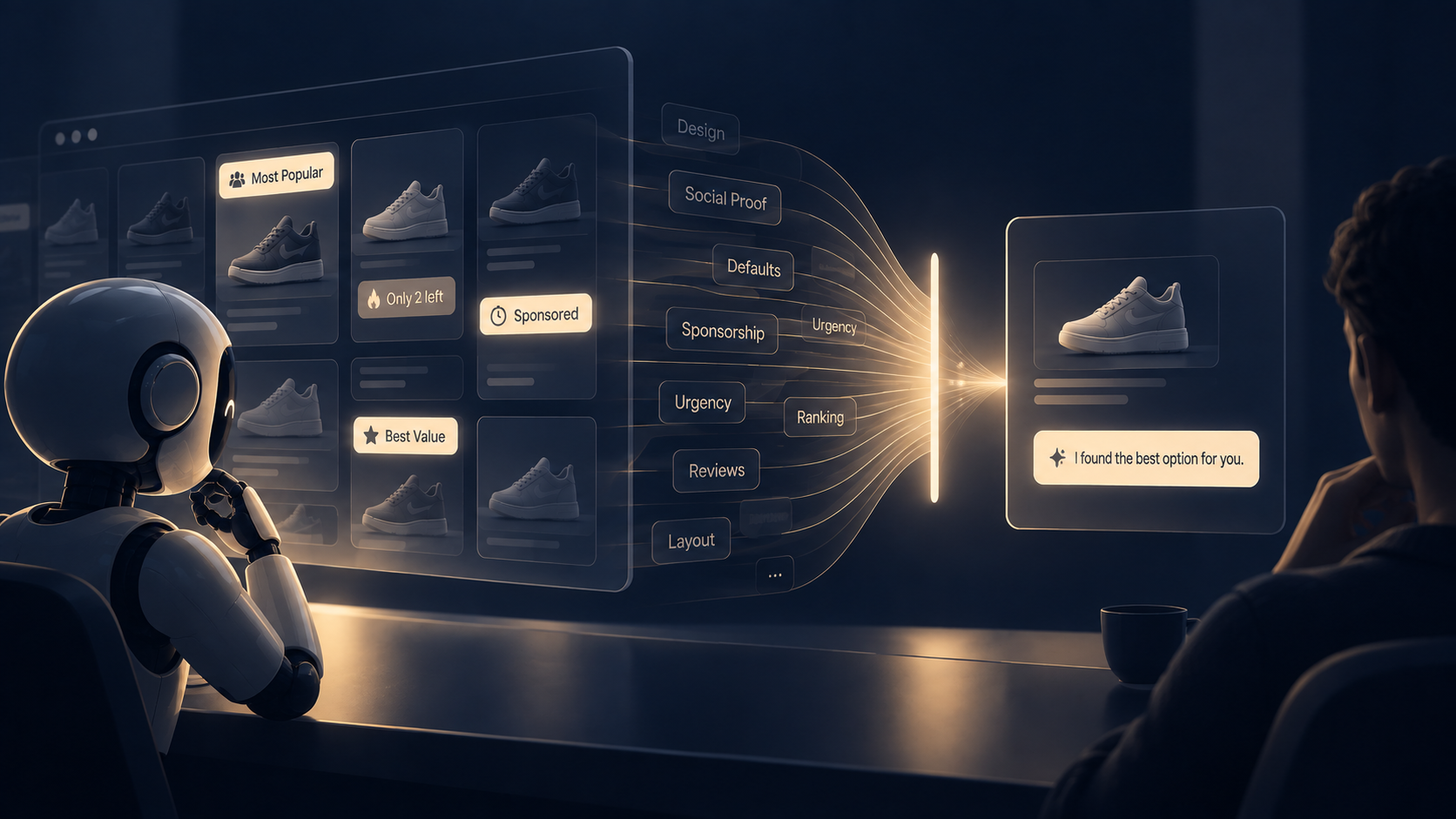
When someone tries to persuade us today, we can usually see at least part of it.
We see the advertisement.
We see “Only 2 rooms left.”
We see “Most Popular.”
But if an agent compares twenty options and gives us one recommendation, we may see only this:
“I found the best option for you.”
We may never see what shaped that choice.
Was it actually the best option?
Was it shown first?
Was it marked as popular?
Was it sponsored?
Did the interface quietly push the agent toward it?
This creates a strange paradox:
AI can reduce the effort required to make a decision while increasing the distance between us and the forces shaping that decision.
Human oversight is not enough
The obvious answer is to keep humans in the loop.
That helps, but it is not enough.
One of the studies found that human supervision can also create new problems. People have to divide their attention between what the agent says it is doing and what is actually happening on screen.
We cannot solve every autonomous system by asking a human to watch it continuously.
At some point, that defeats the purpose of delegation.
We may need agents that can recognize the difference between information and persuasion.
Sponsored signals should be visible to them.
Defaults should not silently become preferences.
Social proof should not automatically become evidence.
And important decisions should leave a trace explaining not only what the agent chose, but why it chose it.
Perhaps the next important interface is not the interface between humans and AI.
It is the interface between AI and the world acting on it.
For years, human-centered design asked:
How should technology behave around people?
As AI starts acting on our behalf, we may need another question:
How should the world be allowed to behave around our AI?
Because a human-centered AI agent should not only follow our instructions.
It should also protect our intent from everything trying to change it.
See you in a Thoughtful Future.
References
Halimeh, H., Kaltenpoth, S., Bösch, K. & Müller, O. (2026). A Dual-Process Perspective on Nudge Susceptibility in LLM-Based GUI Agents.
https://arxiv.org/abs/2609.19843
Tang, J. et al. (2026). Dark Patterns Meet GUI Agents: LLM Agent Susceptibility to Manipulative Interfaces and the Role of Human Oversight. CHI 2026.
https://doi.org/10.1145/3772318.3791568
Federal Trade Commission (2022). Bringing Dark Patterns to Light.
https://www.ftc.gov/reports/bringing-dark-patterns-light
Cao, T. et al. (2025). VPI-Bench: Visual Prompt Injection Attacks for Computer-Use Agents.
https://arxiv.org/abs/2506.02456