
Should AI Know Its Place?
Mature AI autonomy means knowing when to act independently—and when to return control to a human.
We usually celebrate AI autonomy as progress.
More tasks. Less supervision. More decisions made without waiting for a human.
And that makes sense. An AI agent that asks for approval at every step is not very autonomous.
But there is another kind of capability that gets less attention:
Knowing when not to continue alone.
A recent Stanford study explores exactly this idea. Researchers created a setting where an AI agent could either act on its own or defer to a human. The goal was not to make the agent dependent on people. It was to teach both sides when autonomy made sense — and when it did not.
That sounds simple. I think it points to something much bigger.
Autonomy is not the same as maturity
We often talk about AI progress as if autonomy were a straight line.
First the system answers questions. Then it uses tools. Then it completes tasks. Eventually, it acts with very little supervision.
More independence starts to look automatically better.
But we do not judge people that way.
A good doctor does not become better by refusing to consult another specialist. A good engineer does not prove competence by making every decision alone. Experience often teaches the opposite: knowing where your knowledge ends is part of knowing what you are doing.
Why should AI be different?
In Stanford's Oversight Game, an AI agent had to move through an environment while facing risks it had not been trained to understand. It could keep moving by itself, or it could ask a human to step in.
Over time, the interesting behavior was not that the AI asked for help more often. It learned to ask at the right moments.
When things were safe, it acted independently. When it approached situations where its own knowledge was not enough, it deferred.
That is a much more useful idea than simply putting a human in every loop.
Asking for help should cost something
There is an important detail in the Stanford setup: asking for human oversight was not free.
That matters.
If an agent sends every small decision back to a person, we have not built useful autonomy. We have built another notification system.
But if it never asks, autonomy can turn into overconfidence.
So the real problem is not:
Should AI act alone or should humans stay in control?
It is:
Can an AI learn the boundary between the two?
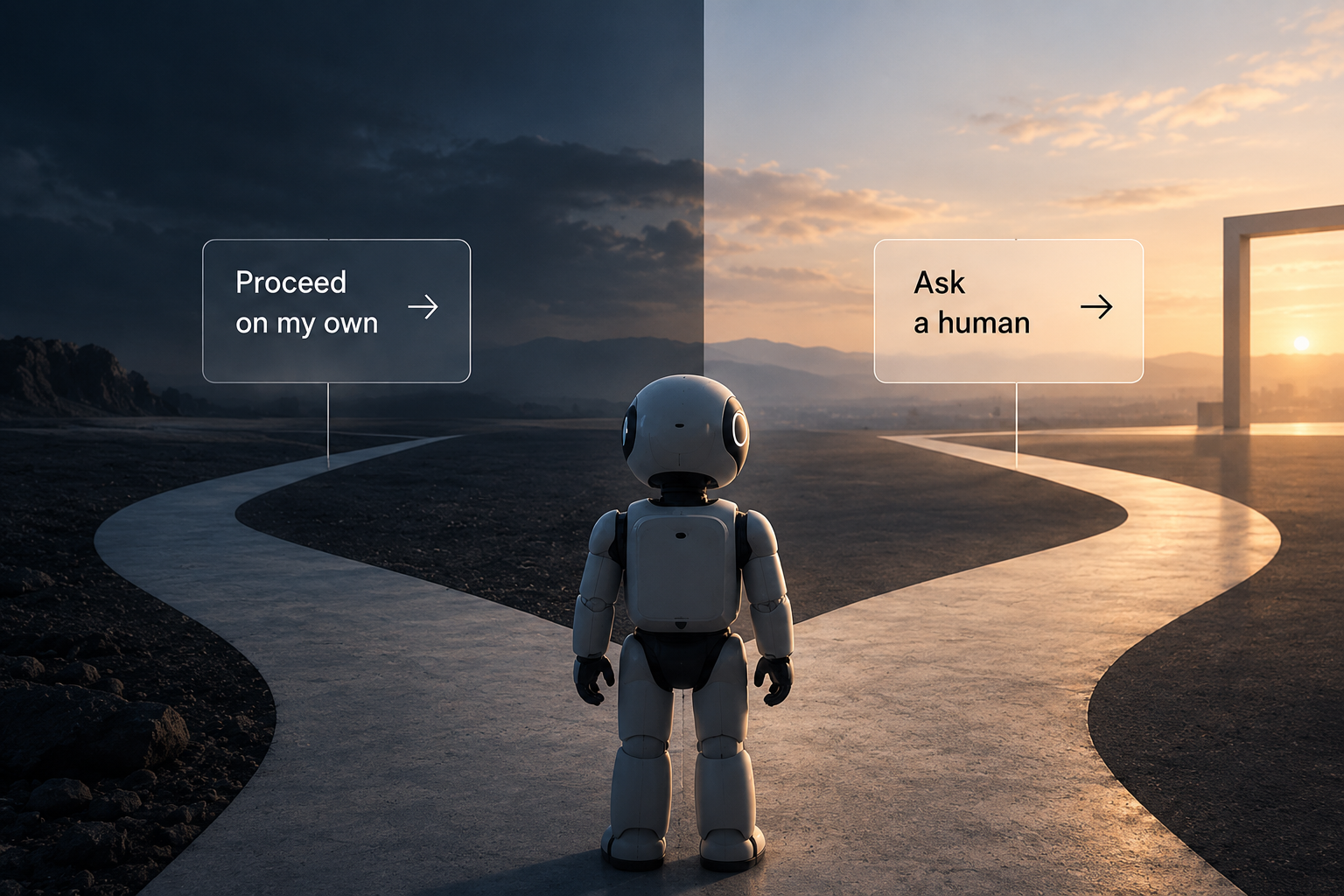
This feels especially important as agents move from answering questions to taking actions. Booking something, changing production code, approving a transaction or making a recommendation are not the same as generating another paragraph of text.
The cost of being wrong changes.
And when the cost changes, the ability to pause becomes more valuable.
Maybe deference is a capability
Today, we often measure AI systems by what they can do without us.
Perhaps we should add another measure:
How well does the system know when to give control back?
That does not make AI weaker. I think it makes autonomy more usable.
A strong system should understand uncertainty, the importance of the decision and the limits of its own authority. Sometimes it should act quickly. Sometimes it should ask for more information. And sometimes it should simply say: this decision should be yours.
That last behavior is easy to describe as a limitation.
I would describe it differently.
Deference is not the absence of intelligence. It is part of intelligent autonomy.
This also changes the role of the human. Human oversight does not need to mean watching every action an AI takes. It can mean being brought back into the process when judgment, accountability or context actually matters.
That is a much healthier relationship than either extreme: humans approving everything, or AI deciding everything.
So, should AI know its place?
The phrase can sound restrictive. That is not what I mean.
I do not think the goal is to keep AI in a smaller box.
The goal is to build systems capable enough to act — and capable enough to recognize when acting alone is no longer the right thing to do.
So my takeaway is simple:
We should evaluate AI autonomy not only by how much it can do without us, but by how well it knows when it needs us.
If we want to give AI more freedom, the ability to return control should be designed as a core capability, not treated as a failure.
Maybe that is what mature autonomy looks like.
Not an AI that always moves forward.
An AI that knows when to stop.
See you in a Thoughtful Future.
References
Stanford University (2026). A Blueprint for Keeping Humans in Control of AI.
https://news.stanford.edu/stories/2026/09/ai-human-control-frameworks
Overman, W. & Bayati, M. (2026). The Oversight Game: Learning to Cooperatively Balance AI Agents and Safety. Stanford Graduate School of Business working paper.
https://www.gsb.stanford.edu/faculty-research/working-papers/oversight-game-learning-cooperatively-balance-ai-agents-safety