Knowledge Is More Than Prediction
AI is making answers cheaper to produce. Verification, reproduction, and human judgment turn them into knowledge we can trust.
There is a difference between producing an answer and creating knowledge.
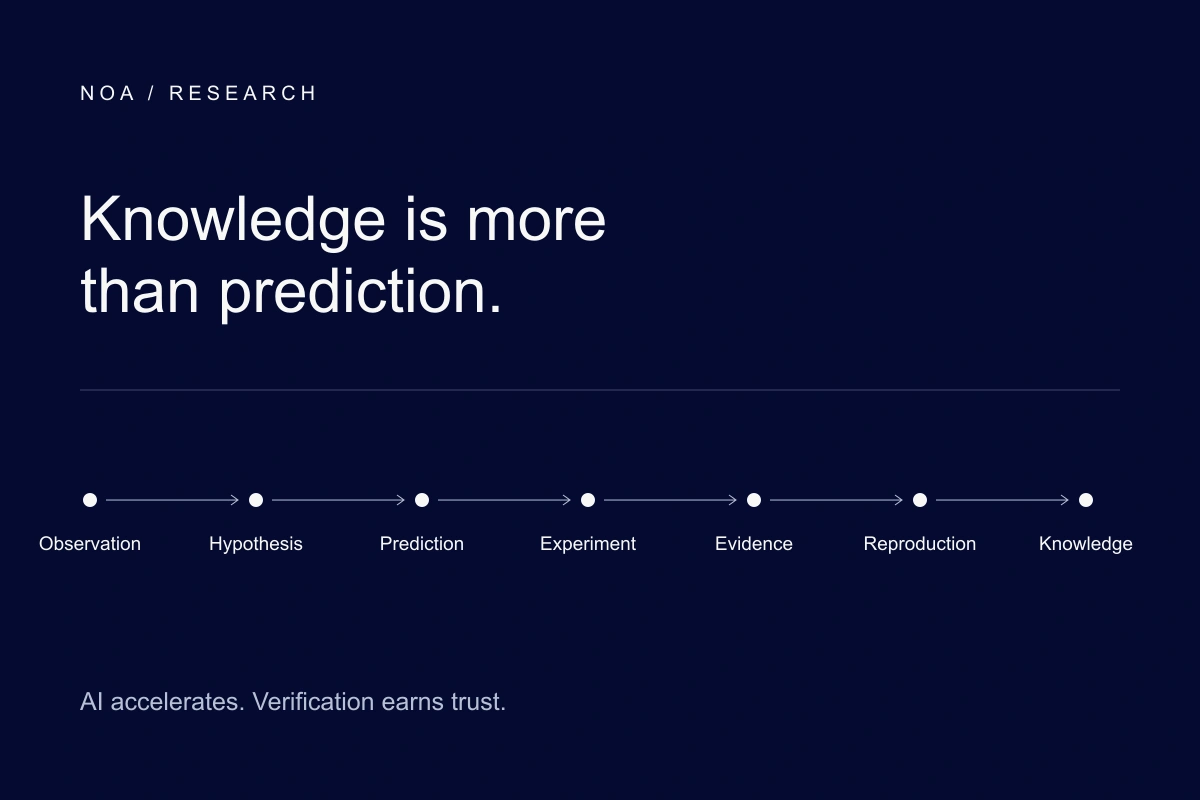
For most of scientific history, the two moved at roughly the same human speed. We observed something, proposed an explanation, designed an experiment, examined the evidence, challenged the result, and tried to reproduce it.
Only after surviving that process could an idea slowly become part of what we considered knowledge.
AI is beginning to change the speed of this cycle.
Research agents can already search literature, generate hypotheses, design experiments, write code, analyze results and draft scientific papers. The cost of producing a plausible answer is falling dramatically. Recent research suggests that this is creating a new problem: AI-generated scientific claims may soon grow faster than our ability to verify them.
That distinction matters.
A hypothesis is not knowledge.
A prediction is not knowledge.
And an answer that sounds convincing is certainly not knowledge.
Science has never earned its credibility from its ability to generate ideas. It earns credibility from what happens after an idea appears.
A simplified version of that journey looks something like this:
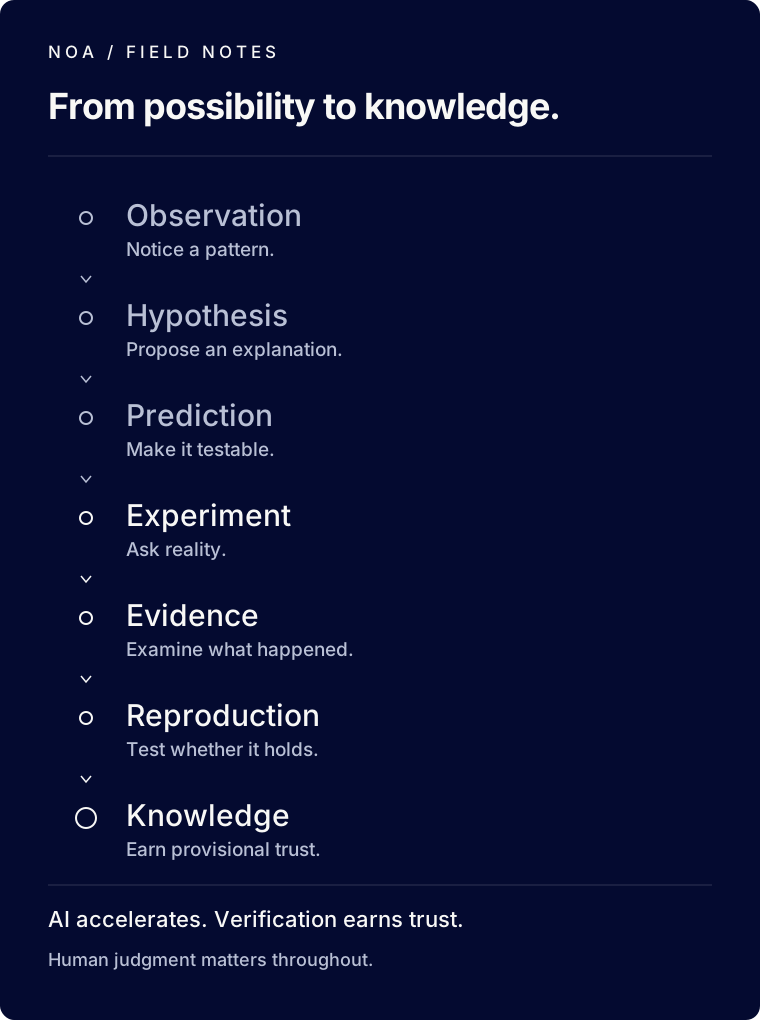
AI can accelerate almost every part of this chain. But acceleration does not remove the need for the chain itself.
In fact, the faster AI becomes at producing hypotheses and experiments, the more valuable verification becomes.
Google DeepMind recently described essentially the same problem as a coming validation bottleneck in science: AI agents may generate ideas faster than laboratories, reviewers and scientific institutions can validate them. Their researchers argue that scientific infrastructure—from experimental capacity to peer review—may need to change accordingly.
This changes the role of the human scientist.
If machines become exceptionally good at asking “What could be true?”, perhaps a growing part of human scientific work becomes asking:
“How do we know this is true?”
That requires more than checking the final answer.
It means understanding where evidence came from. Reproducing results. Challenging assumptions. Identifying alternative explanations. Knowing when a statistically impressive result is scientifically meaningless. And ultimately accepting responsibility for what enters our shared body of knowledge.
This is why the future of AI-assisted science should not simply optimize for the number of discoveries produced.
It should optimize for the number of discoveries we can trust.
Science has faced versions of this problem before. Peer review, statistical standards and reproducibility practices all emerged because producing claims and establishing knowledge are different activities. AI does not invalidate those principles. If anything, it makes them more important.
AI may soon make generating answers extraordinarily cheap.
Proving them will remain expensive.
And perhaps that is exactly where humans become more important, not less.
Knowledge is not what we can predict. It is what survives our attempts to prove it wrong.
References
- Belinda Mo. The Age of AI Agents Demands A New Scientific Paradigm To Sustain Trustworthy Science (2026). arXiv paper.
- Ding et al. Autonomous Research Agents: A Survey of AI Scientists and the Verification Gap (2026). arXiv paper.
- Google DeepMind. Conjecture machines, AI agents and the new validation bottleneck in science.