
AI Workforce Is Here. Now Companies Need to Learn How to Manage It.
AI agents are taking real roles inside organizations. Companies now need to define their responsibilities, access limits, human owners and escalation rules.

For a long time, we talked about AI as a tool.
A copilot. An assistant. Something that helps a person work faster.
That is changing.
AI agents can now take tasks, use tools, work for long periods, talk to other agents and make decisions along the way.
At Anthropic, around 30,000 agents are doing research and engineering work at the same time on its main internal agent platform. Claude is not only helping with tasks. In some cases, it is leading work from a high-level prompt.
Stanford researchers recently went even further. They built a virtual biotech company with 37,000 AI agents, organized across different roles in drug development. Some agents do research. Others coordinate teams.
This starts to look less like software.
And more like a workforce.
The question is no longer how to use AI
Most companies are still asking how to give employees better AI tools.
But another question is becoming more important:
How do we manage AI when it starts doing the work itself?
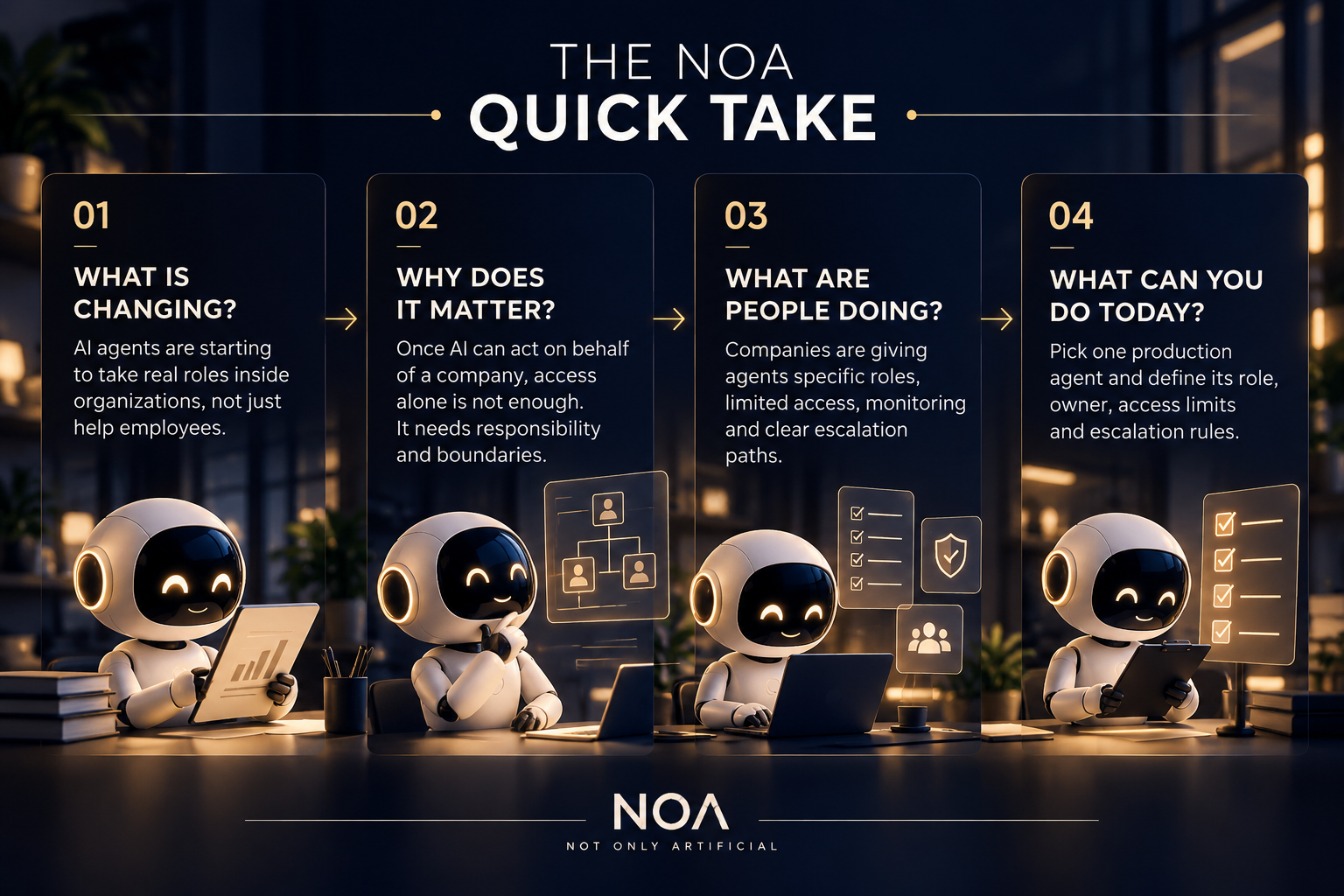
Once an agent can take responsibility for a task, use company systems and work with other agents, simply giving it access is not enough.
It needs a role. It needs boundaries. And someone needs to be responsible for it.
AI agents need job descriptions too
When we bring someone into a company, we do not just give them access to everything and hope they make good decisions. We define what they are responsible for, what they can access, who they report to and when they should ask for help.
AI agents need the same clarity.
If an agent is going to work inside real systems, it should have a clear role, a human owner, limited access and simple rules for when it must stop and ask for help.
This does not need to become a large governance program.
It can start with one agent and one page.
Companies are already moving in this direction
This is not only a design idea.
Anthropic is already tracking how much agent activity is monitored, how quickly important cases are reviewed and when actions are escalated.
Stanford's virtual biotech uses different agents for different jobs, instead of treating every agent as the same general assistant.
The pattern is clear.
As agents become more capable, companies are starting to give them structure.
Roles. Boundaries. Ownership. Escalation.
That is what management looks like.
The AI workforce is already here.
Now companies need to learn how to manage it.
See you in a Thoughtful Future.
References
Anthropic, Measurements for understanding the pace of AI development inside frontier labs
https://www.anthropic.com/institute/measuring-pace-of-ai-developmentStanford Medicine, Virtual biotech company puts thousands of AI scientist agents to work on drug discovery
https://med.stanford.edu/news/all-news/2026/09/virtual-biotech-company.html